Gemini 3 Pro vs Claude Opus 4.8: The Complete Guide 2026
Gemini 3 Pro vs Claude Opus 4.8 compared on coding, reasoning, speed, and price. See which model wins each task and when to route between them.



Gemini 3 Pro and Claude Opus 4.8 are the two models most teams weigh when they want a frontier model in 2026.
Before the numbers, one clarification that matters: Gemini 3 Pro's current release is Gemini 3.1 Pro. Google is retiring the original 3 Pro Preview and moving everyone to 3.1 Pro, so every Gemini figure below is the shipping 3.1 Pro, the model you actually get when you call Gemini 3 Pro today.
Neither model wins outright. Claude Opus 4.8 is the stronger agentic coder. Gemini 3 Pro is faster and cheaper. For most teams the right answer is not to pick one, it is to route each task to the model that owns it.
Here is the short version:
- Reach for Claude Opus 4.8 when the work is hard agentic coding, multi-file refactors, or anything where reliability matters more than cost.
- Reach for Gemini 3 Pro when you need speed, low cost, high volume, or multimodal input.
- Use both when your workload is mixed, which describes almost every real product.
The 30-second verdict
Claude Opus 4.8 is the sharper engineer. It leads on the coding and agentic benchmarks that predict how an autonomous agent behaves across a real codebase, and it makes fewer confident mistakes. Anthropic ships it with a 1M token context window and dynamic parallel-subagent workflows in Claude Code, built for migrations that span an entire repo.
Gemini 3 Pro is the faster, cheaper generalist. It runs roughly twice as fast and about 2.5x cheaper on input, matches Opus on context window, and carries Google's multimodal strength for image and video input. For high-volume pipelines where you are paying per token at scale, that price and speed gap compounds fast.
The old tiebreaker used to be context window. That is gone. Both models now ship a 1M token window, so the deciding factor is no longer how much you can load, it is how well each model thinks across what you load.
Benchmarks, head to head
Every number here is the vendor-reported or standardized figure for the current shipping model, linked to its source.
| Dimension | Gemini 3 Pro (3.1 Pro) | Claude Opus 4.8 | Edge |
|---|---|---|---|
| Context window | 1M tokens | 1M tokens | Tie |
| SWE-bench Verified | 80.6% | 88.6% | Opus 4.8 |
| GPQA Diamond | 94.3% | ~94% (within a point) | Tie |
| ARC-AGI-2 (novel reasoning) | 77.1% | not published | Gemini 3 Pro |
| Intelligence Index (Artificial Analysis) | 46 | 56 | Opus 4.8 |
| Output speed | ~129 tokens/sec | ~60 tokens/sec | Gemini 3 Pro |
| Price (input / output per 1M) | $2 / $12 | $5 / $25 | Gemini 3 Pro |
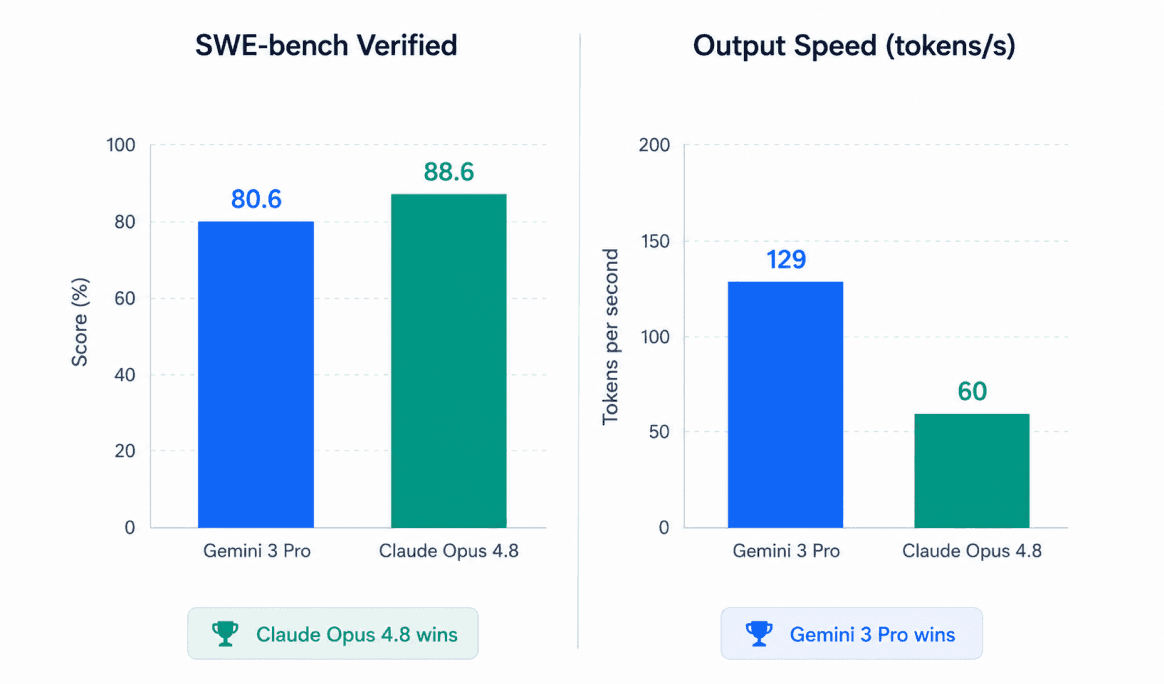
Read the table as two clusters. Opus 4.8 owns raw coding accuracy and the composite intelligence score. Gemini 3 Pro owns speed and price. On knowledge reasoning like GPQA the two are inside the margin of error, and on the ARC-AGI-2 novel-reasoning test Gemini pulls ahead. The window is a wash.
Where Claude Opus 4.8 pulls ahead
Opus 4.8 is the model to trust with an autonomous coding agent. It scores 88.6% on SWE-bench Verified against Gemini's 80.6%, an eight-point gap on the benchmark that best tracks resolving real GitHub issues. On the harder SWE-bench Pro it reaches 69.2% and Terminal-Bench 2.1 hits 74.6%, the kind of long-horizon terminal work that breaks weaker agents.
The gap that does not show up in a single number is reliability. In cross-file work, Opus 4.8 traces dependencies that span files and resists inventing change points that were not actually there, while Gemini 3 Pro is more likely to produce a false positive and suggest edits to files that did not need touching. For an agent running unattended, a confident wrong edit is worse than a slow one.
Opus 4.8 also leads the Artificial Analysis Intelligence Index at 56 to Gemini's 46, and it ships parallel-subagent workflows in Claude Code, where the model spawns subagents that each plan, execute, and verify a slice of a large task and report to an orchestrator. That is built for codebase-scale migrations, not single-file edits.
Where Gemini 3 Pro wins
Gemini 3 Pro wins on the economics of running a model at scale. It generates about 129 tokens per second to Opus 4.8's 60, so interactive and streaming workloads feel noticeably snappier. And it lists at $2 input and $12 output per million tokens against Opus 4.8's $5 and $25, roughly 2.5x cheaper on input. Across a pipeline that processes millions of tokens a day, that is the difference between a viable unit economic and a bleeding one.
It is also the stronger novel reasoner on ARC-AGI-2, where it jumped to 77.1% in this release, and it carries Google's multimodal lineage for image and video understanding. If your product feeds the model screenshots, documents, or frames, Gemini 3 Pro is the natural default.
Context and multimodal
Because both models now sit at a 1M token window, long-context capacity is no longer a reason to pick one over the other. What differs is what each does best inside that window. Gemini 3 Pro leans into mixed media, reading images and video alongside text.
Opus 4.8 leans into code, holding a large repository in context and reasoning across files without losing the thread. Match the window to the payload: media-heavy work to Gemini, code-heavy work to Opus.
Which should you actually use?
Skip the leaderboard and map it to the job:
- Agentic coding, multi-file refactors, repo migrations: Claude Opus 4.8.
- High-volume summarization, extraction, classification, chat: Gemini 3 Pro.
- Cost-sensitive or latency-sensitive pipelines: Gemini 3 Pro.
- Reliability-critical work an agent runs unattended: Claude Opus 4.8.
- Multimodal input, image or video: Gemini 3 Pro.
- Hard knowledge reasoning: close enough to test both on your own prompts.
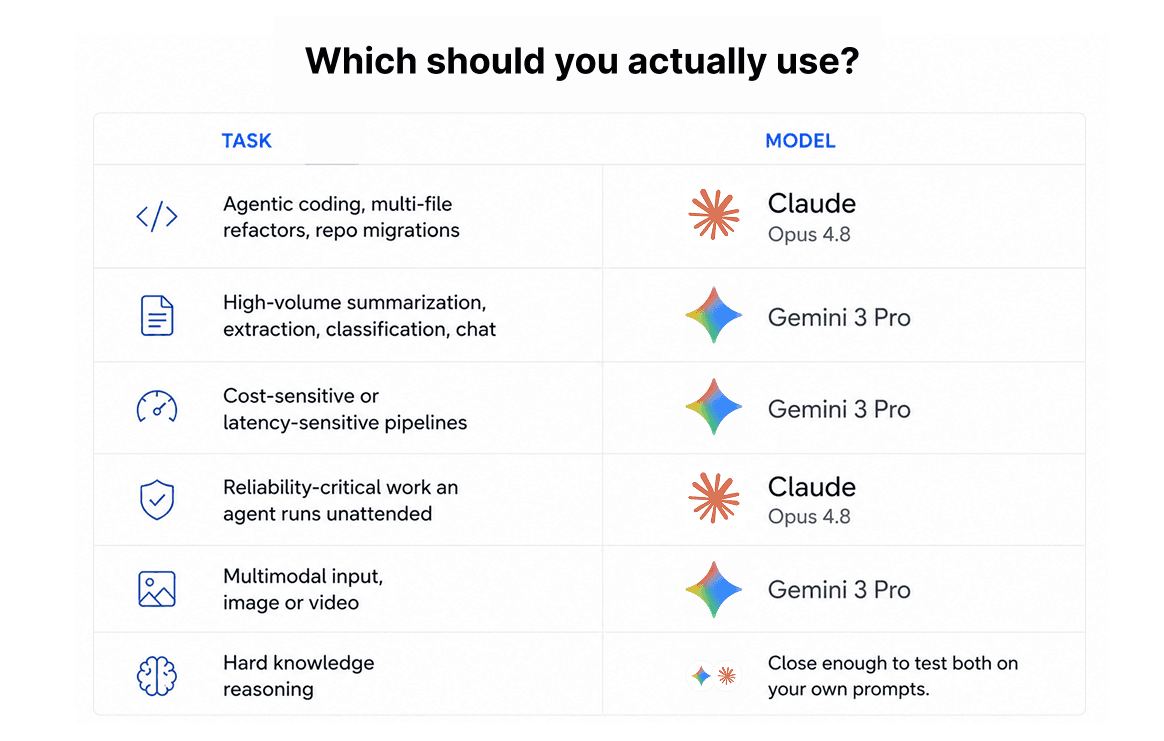
Notice that the list splits down the middle. That is the point. A real workload is a mix of hard coding, cheap high-volume calls, and the occasional multimodal task, and no single model is the right pick for all three.
You don't have to choose: route between them
The honest conclusion of every frontier-model comparison in 2026 is the same.
The best setup is not one model, but the right model per task. We reached the same verdict comparing Opus 4.8 to Grok 4.5: route, don't marry.
The catch is that running both yourself means two API accounts, two billing relationships, two SDKs, and a layer of routing glue you have to build and maintain. That is real engineering time spent on plumbing instead of product.
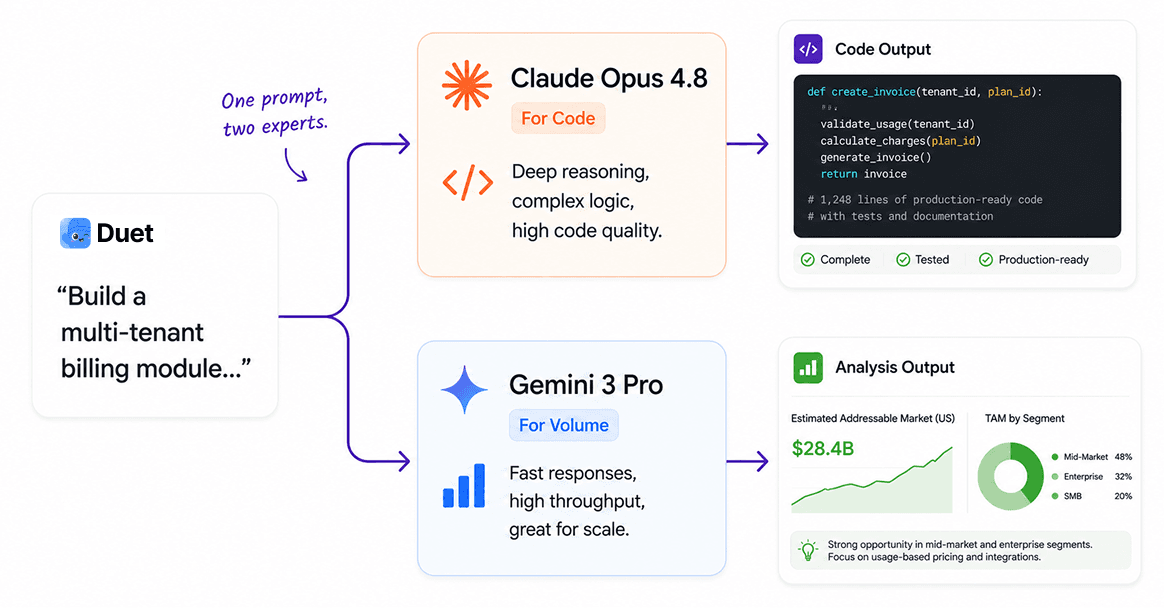
This is what Duet is for. Duet runs Claude Opus and Gemini in one managed workspace and sends each task to the model that wins it, so you get Opus 4.8 for the hard agentic coding and Gemini 3 Pro for the cheap high-volume work without wiring the routing yourself. You can even run Claude Code in the cloud on the same workspace, persistent and resumable from any device.
Want both models behind one workspace? Try Duet free. No two accounts, no routing code, no per-model glue.
Frequently Asked Questions
Is Gemini 3 Pro better than Claude Opus 4.8?
Neither is better across the board. Claude Opus 4.8 leads on agentic coding and overall intelligence score, while Gemini 3 Pro is faster, cheaper, and stronger on multimodal input. The better model depends on the task, which is why many teams route between them.
Which is better for coding, Gemini 3 Pro or Claude Opus 4.8?
Claude Opus 4.8. It scores 88.6% on SWE-bench Verified to Gemini 3 Pro's 80.6%, leads on harder agentic benchmarks like Terminal-Bench, and makes fewer confident cross-file mistakes, which matters most when an agent runs unattended.
Which model has the bigger context window?
They tie. Both Gemini 3 Pro (3.1 Pro) and Claude Opus 4.8 ship a 1M token context window, so window size is no longer a deciding factor between them.
Is Claude Opus 4.8 better for agentic tasks?
Yes. Opus 4.8 leads the agentic coding benchmarks and ships parallel-subagent workflows in Claude Code that plan, execute, and verify slices of large tasks. Its cross-file reliability makes it the safer choice for autonomous agents.
How much does each model cost?
Gemini 3 Pro lists at $2 per million input tokens and $12 per million output tokens. Claude Opus 4.8 lists at $5 input and $25 output. Gemini is roughly 2.5x cheaper on input, which compounds at high volume.
Which model is faster?
Gemini 3 Pro. It generates around 129 tokens per second to Claude Opus 4.8's roughly 60, so it feels faster in interactive and streaming use.
Can I use Gemini 3 Pro and Claude Opus 4.8 together?
Yes, and for most teams that is the strongest setup. You can call each model's API directly and build your own routing, or use a workspace like Duet that runs both and routes each task to the model that fits it.
Which is better for writing and long-form content?
They are close. Both handle long-form well within their 1M windows. Gemini 3 Pro is faster and cheaper for high-volume drafting, while Opus 4.8 tends to hold a more consistent voice across very long documents. Test both on your own style.
Keep reading
- Grok 4.5 vs Claude Opus 4.8: the same route-between-them verdict on a different matchup.
- How to run Claude Code in the cloud: put Opus 4.8 on a persistent cloud workspace.
- Claude Code vs Cursor vs Codex: pick the right AI coding tool, not just the right model.
- Codex vs Claude Code: features, benchmarks, and which agent to use.