Duet vs OpenAI Workspace Agents vs Claude for Small Business vs Viktor (2026 Guide)
Duet, OpenAI Workspace Agents, Claude for Small Business, and Viktor compared on persistence, team fit, build+run, integrations, pricing, and SMB fit.

Duet Team
In 2026, four very different products are competing for the same SMB and small-team AI lane: Duet, OpenAI Workspace Agents, Anthropic's Claude for Small Business, and Viktor.
They all promise an "AI coworker," but the shape underneath each one is different.
This guide compares them on the dimensions that actually decide which one to pick.
TL;DR
| Product | What it is | Shape | Best for |
|---|---|---|---|
| Duet | Cloud agent workspace: private server, persistent AI teammate, channels, files, apps | Standalone workspace, team-native, build + run | Small teams that want one named AI coworker across every tool |
| OpenAI Workspace Agents | Agents launched as part of OpenAI's workspace surface for business users | Agents inside the OpenAI product surface | Teams already standardized on ChatGPT Business / Enterprise |
| Claude for Small Business | Anthropic's packaged SMB AI: 15 prebuilt workflows + 15 skills with human approval | AI as a toggle inside connected SaaS (QB, HubSpot) | Owners whose work already lives inside packaged SaaS |
| Viktor | "Autonomous AI coworker" that lives inside Slack / Microsoft Teams with 3,000+ integrations | Per-seat SaaS agent layered on top of a messenger | Teams whose work happens in Slack/Teams and want a plug-in AI teammate |
Questions this page answers
- What is the difference between Duet, OpenAI Workspace Agents, Claude for Small Business, and Viktor?
- Which AI coworker is best for a small business in 2026?
- Does Duet integrate with Slack like Viktor does?
- Is Claude for Small Business better than OpenAI Workspace Agents?
- Which of these can actually build and host a custom app?
- Which is the cheapest for a 5–15 person team?
What is Duet?
Duet is a cloud agent workspace. Every user and team gets a private cloud server with a persistent, always-on AI teammate. The chat and channel layer is the collaboration interface, not the product. The product is the agent plus the server, plus memory, files, cron, skills, and app hosting.
The core wedge is Build and Run. Lovable builds you an app and leaves. Duet builds you an app and runs it. The AI coworker shows up tomorrow with full memory of yesterday, the files it created, the integrations you connected, and the scheduled jobs you set up.
Every Duet workspace gets a private Debian sandbox with Node, Python, and Bun, persistent file storage, cron scheduling, a skills system, hosting for any web app the agent builds (with custom domains), and multi-model routing across Claude, GPT, Gemini, and xAI.
What are OpenAI Workspace Agents?
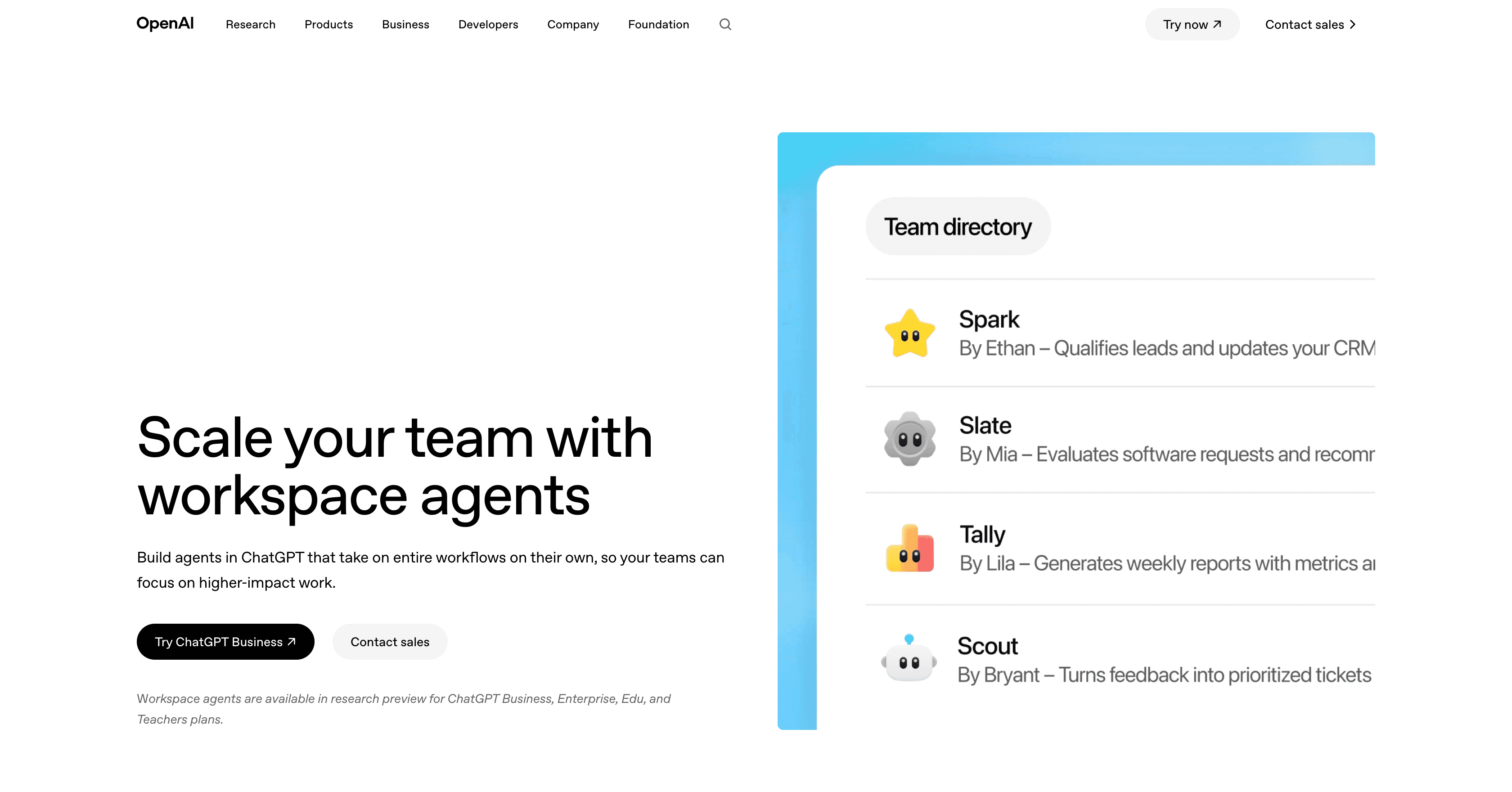
OpenAI Workspace Agents are OpenAI's shared-agent feature inside ChatGPT — see the April 2026 update below for what changed, who's eligible, and what it costs now.
In practice, Workspace Agents are an extension of OpenAI's existing surface: shared workspaces, admin controls, and OpenAI-owned connectors. They are appearing in category searches alongside Duet, Claude for Small Business, and Viktor as a "business AI agent" option, which is why they belong in this comparison even though they are not pitched as an SMB-specific product the way Anthropic's launch is.
In practice, Workspace Agents can browse websites, run code for data analysis, generate slides and spreadsheets, and connect to dozens of tools, including Slack, Gmail, Google Calendar, SharePoint, Drive, Salesforce, Notion, and Atlassian.
Agents can run on a cron-style schedule, pause for human approval, and resume, making them capable of multi-step workflows that span hours. Custom integrations beyond the built-in connectors can be wired through the Model Context Protocol (MCP). The shape is broad and horizontal: if ChatGPT can do it, a Workspace Agent can do it on a schedule.
OpenAI Workspace Agents: What Changed for Teams Since the April 2026 Launch?
OpenAI Workspace Agents are Codex-powered shared agents inside ChatGPT Business, Enterprise, Edu, and Teachers — not Plus or Pro. Launched April 22, 2026 and generally available May 21–22, they run scheduled cloud workflows with files, tools, memory, and Slack. Since July 6, 2026, runs use token-based credits; a typical GPT-5.5 run costs about 5–25 credits.
Who can use OpenAI Workspace Agents now?
You need a ChatGPT Business, Enterprise, Edu, or Teachers plan. Personal Plus ($20/mo) and Pro ($100/mo) don't include workspace agents at all.
OpenAI's launch announcement lists all four eligible plans. Its dated release notes name Business, Enterprise, and Edu specifically in the generally-available entry — treat Teachers as listed-but-not-explicitly-GA-confirmed, not dropped and not promoted.
Enterprise workspaces ship agents off by default; an admin has to turn them on. Business workspaces ship them on by default. Weighing OpenAI's surface against a Codex-based build? Eligibility is the first filter.
What do OpenAI Workspace Agents cost now that the free period has ended?
Free access ended July 6, 2026, per OpenAI's release notes. Runs now bill on a published token-credit rate card, on top of the ChatGPT Business seat price.
ChatGPT Business is $25/user/mo billed monthly, or $20/user/mo billed annually (2-user minimum) — OpenAI's business plan page confirms both rates. That seat buys the workspace; agent runs draw separately from a shared pool of Codex credits.
| Model | Input (per 1M tokens) | Cached input (per 1M) | Output (per 1M) |
|---|---|---|---|
| GPT-5.5 | 125 credits | 12.50 credits | 750 credits |
| GPT-5.4 | 62.50 credits | 6.25 credits | 375 credits |
OpenAI's own worked example: 20k input + 80k cached input + 5k output tokens ≈ 7.25 credits. A typical end-to-end GPT-5.5 run costs about 5–25 credits, per OpenAI's rate card.
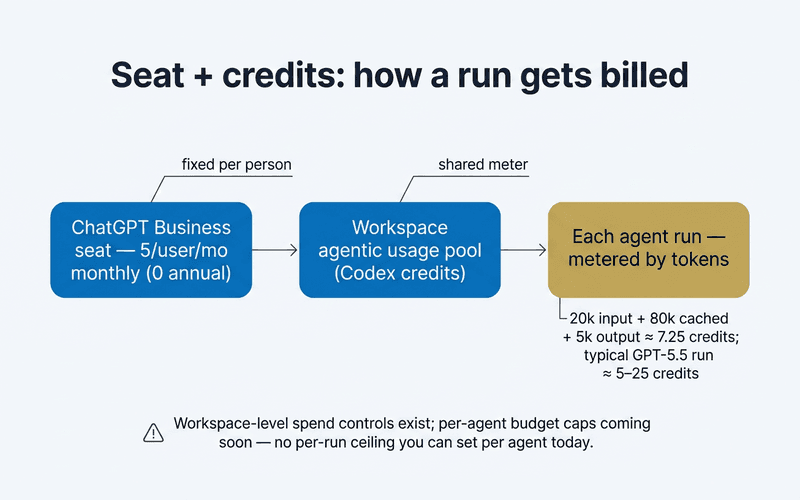
Someone still has to watch that meter — who runs your agent after you build it matters more once runs bill by the token instead of the seat.
Is memory actually shared across the team?
No. OpenAI's own documentation says an agent's memory is not shared across different end users — only the agent's definition is.
The cookbook is explicit: memory "is not shared across different end users of our agent." The Security Overview adds the Slack half — memory is scoped per-user for ChatGPT runs and per-deployed-channel for Slack runs, and the two pools are never cross-referenced.
| Object | Shared across the team? | Source |
|---|---|---|
| Agent definition (instructions, tools, connectors) | Yes — reusable per workspace group membership | OpenAI Help Center |
| Connected files/folders | Yes, if the agent's connections are shared | Cookbook + Help Center |
| Per-user memory (notes, drafts, learned preferences) | No — scoped to the individual end user | Cookbook; Security Overview |
| Slack-channel memory | Separate pool — not cross-referenced with ChatGPT memory | Security Overview |
| Durable project/run history a teammate can pick up | Partial — logged to the Compliance Platform (Enterprise/Edu); no shared "run inbox" | Security Overview |
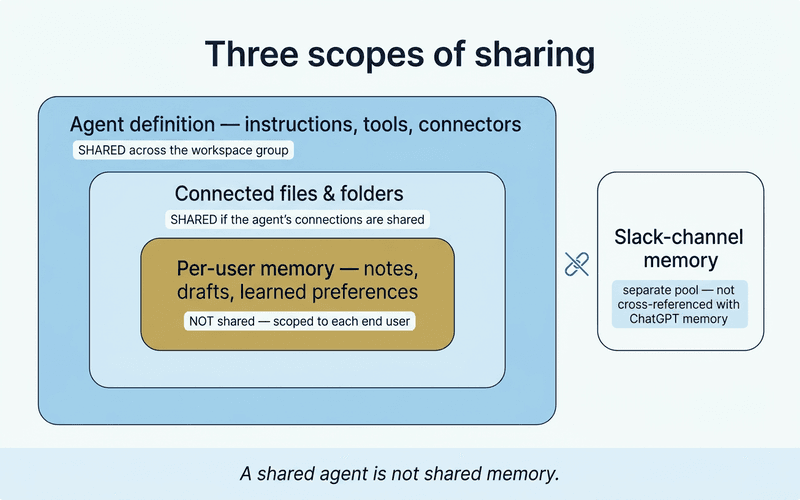
Everyone on the team can run the same agent. Nobody inherits a teammate's notes.
OpenAI Workspace Agents vs Claude Cowork vs an owned agent workspace — which fits your team?
Workspace Agents is the managed option living inside ChatGPT. Claude Cowork — a separate, personal/local Anthropic product from the Claude for Small Business profile above — skews individual and local-file. An owned, persistent workspace keeps files, memory, schedules, and outputs as the operating layer regardless of model.
| Dimension | OpenAI Workspace Agents | Claude Cowork | Owned shared agent workspace |
|---|---|---|---|
| Execution surface | Cloud, inside ChatGPT | Desktop / local files | Persistent private cloud server |
| Team sharing | Agent definition shared by workspace group | Personal, single-user routines | Team-native by default |
| Memory scope | Per-user (ChatGPT); per-channel (Slack); never cross-user | Local to that one user | Persistent, team-owned workspace memory |
| Durable state | Partial — Compliance logs (Enterprise/Edu); no shared run inbox | Local files on that user's machine | Files, cron, and run artifacts persist on the team's own server |
| Ownership / portability | Data lives inside OpenAI's product surface | Data lives on the user's device | Workspace and files stay the team's own |
| Pricing model | Business seat $25/user/mo + token credits | Rides on a paid Claude tier | Usage-based credits at cost, no per-seat tax |
| Best fit | Teams already standardized on ChatGPT/Slack | One strong individual, local-file worker | Teams that need files, memory, schedules, and outputs to persist as one operating layer |
Pick the shape that matches how the work actually lives, not just which model is smartest:
- Pick Workspace Agents if the team already standardizes on ChatGPT and wants governed shared agents inside ChatGPT and Slack.
- Pick Claude Cowork for a strong personal, local-file worker.
- Pick a durable, owned agent workspace when the business needs persistent files, memory, schedules, run artifacts, and hosted outputs to remain the operating layer across whichever agents or models it uses.
None of this is really a question of which agent is smartest — it's a question of where the work lives once the demo ends. OpenAI's workspace agents are a genuinely capable feature inside ChatGPT's surface: governed, team-shareable, and — as of this update — priced and dated clearly for the first time.
But they're still a feature of one chat product, scoped to that product's plans and that product's memory model.
Duet takes the other shape: a shared, persistent cloud workspace — an agent drive — that isn't defined by any single chat vendor's surface. Files, memory, schedules, and the apps your agent builds all live in one place your team keeps, independent of which model happens to run a given task.
It's the Build + Run idea: an agent that builds the tool your business needs and keeps running it, not just a chat window you visit.
If your team runs client-adjacent or recurring work and wants to compare that shape directly, see how agencies use a shared agent workspace.
What should you test after the demo?
A scheduled run proving the agent works unattended is a different claim from an inspectable, continuable workspace. Test what happens next, not just whether the demo ran.
- Where do a run's artifacts actually land, and can a teammate find them without asking whoever built the agent?
- Who can see run history and failures — is that an admin/compliance surface only, or something the whole team can check?
- What happens to in-flight work if the teammate who owns the agent's connections leaves?
- Does a month of scheduled runs have a spend ceiling you can set per agent? Workspace-level spend controls exist today; OpenAI's own Security Overview lists per-agent budget caps as "coming soon," not shipped.
- If you trigger an agent by API, can your system retrieve the result? Today that call returns
202 Acceptedwith no run ID — response retrieval is also "coming soon."
That's the real test, and it's the same test whichever platform you're evaluating. AI agent workspace vs. control plane walks through it dimension by dimension; what an agent workspace should include turns it into a checklist you can run against any vendor.
What is Claude for Small Business?
Claude for Small Business is Anthropic's packaged AI product for SMB owners, launched on May 13, 2026. It includes direct connectors into QuickBooks, PayPal, HubSpot, Canva, Docusign, Google Workspace, and Microsoft 365, plus 15 prebuilt workflows and 15 prebuilt skills, with human approval required on outbound actions.
The framing is sharp: AI as a toggle inside the SaaS you already pay for. You open QuickBooks, you click a Claude button, the workflow runs. Pricing rides on top of any paid Claude tier, starting at Pro ($20/month). The target user is the non-technical owner who wants a packaged answer, not a workspace to configure.
What is Viktor?
Viktor is an "autonomous AI coworker with its own persistent cloud computer," launched publicly in February 2026. It lives inside Slack and Microsoft Teams, advertises 3,000+ integrations, and starts at $50/workspace/month (with 20,000 credits included) layered on top of the messenger your team already uses.
Positioning-wise, Viktor is the closest direct competitor to Duet on the "AI coworker" framing. The key structural difference is dependency: Viktor is a guest inside Slack or Teams. If your team does not live in those messengers, Viktor does not have a home; if it does, Viktor is one slash command away from being part of a thread.
Side by Side
| Dimension | Duet | OpenAI Workspace Agents | Claude for Small Business | Viktor |
|---|---|---|---|---|
| Persistence | Private cloud server, persistent files, cron, memory, hosted apps | Account / workspace context inside ChatGPT | Account-level memory, per-conversation context | Cloud compute attached to the per-workspace agent |
| Team-native | Team-native: channels, group chats, AI participates as a teammate | Team workspace inside ChatGPT Business / Enterprise | Shared workspace inside Claude Team / Enterprise | Lives inside Slack / Teams as a participant |
| Build + Run | Build and run: agent builds custom apps and keeps running them | Agent actions, no first-class custom-app hosting layer | Run-only: executes prebuilt workflows, no custom apps | Run-focused: per-workspace agent, no custom-app hosting |
| Integrations | Open connector layer via Composio, plus custom code | OpenAI-owned connectors, growing plugin / app ecosystem | First-party connectors: QuickBooks, PayPal, HubSpot, Canva, etc. | 3,000+ integrations via Slack / Teams ecosystem |
| Deployment | Standalone workspace at duet.so, web + mobile + desktop | Inside ChatGPT (web, desktop, mobile) | Inside Claude product surface | Plugin inside Slack / Microsoft Teams |
| Pricing | Per-org prepaid credits, no per-seat tax | ChatGPT Business $25/user/mo monthly ($20/user/mo annual) + credits | Any paid Claude tier (Pro $20/mo+) | $50/workspace/mo + credits |
| Identity | Named AI coworker with an ID card you "hire" | "ChatGPT" branded agent inside your workspace | AI as a toggle inside existing SaaS | Single named persona ("Viktor") added as a Slack/Teams user |
| SMB fit | Strong for teams that want one workspace across every tool plus apps | Strong for teams already paying for ChatGPT Business | Strong for owners who already live inside QuickBooks / HubSpot | Strong for Slack- or Teams-first teams |
The Core Philosophy Difference
The cleanest way to think about this market is to ask, "what does the AI sit on top of?"
- OpenAI Workspace Agents sit on top of OpenAI. The agent lives where ChatGPT already lives.
- Claude for Small Business sits on top of your existing SaaS. The agent is a toggle inside QuickBooks, HubSpot, and Google Workspace.
- Viktor sits on top of your messenger. The agent is a user inside Slack or Microsoft Teams.
- Duet sits on top of its own cloud workspace. The agent is a named coworker with an ID card, a private server, memory, files, cron, and the ability to build and host apps.
All four shapes are valid, but they bias different teams. If your work is already inside ChatGPT, Workspace Agents make sense. If your work is already inside QuickBooks and HubSpot, Claude for Small Business makes sense. If your work happens in Slack, Viktor makes sense. If you want one AI teammate to span every tool and build its own apps and run scheduled work, Duet makes sense.
When Each One Wins
OpenAI Workspace Agents
When you are already standardized on ChatGPT Business or Enterprise, your team prefers a single OpenAI surface for everything, and you don't need a custom workspace or hosted apps. It is the lowest-friction option for teams that are already inside the OpenAI ecosystem.
Claude for Small Business
When your business runs almost entirely inside packaged SaaS like QuickBooks, HubSpot, Google Workspace, and Microsoft 365, the work you want AI to do maps to one of Anthropic's 15 workflows, and you want first-party connectors with Anthropic on the hook for support. Non-technical owners who want a packaged answer rather than a workspace to configure will be most comfortable here.
Viktor
When your team genuinely lives inside Slack or Microsoft Teams, you don't want to introduce a new product surface, and you are happy paying $50/workspace/month for an AI participant. The 3,000+ integration count is real depth, and being inside the messenger is the lowest-friction onboarding shape for a Slack-first team.
Duet
When you want one named AI coworker, not a feature inside another product, and your work mixes tools, code, files, and scheduled jobs. Duet wins specifically when you want to build and run: have the agent build a custom dashboard, scraper, or internal tool and then keep running it on a private server with a custom domain. It also wins when you don't want a per-seat tax, Duet's prepaid credits mean you pay for the work the agent actually does, not for every human seat that might watch it run.
Use Cases of OpenAI, Claude, Viktor, Duet
Here is what each platform looks like in practice for a 5-to-15-person team.
OpenAI Workspace Agents
A 10-person sales team uses a Workspace Agent to prep for every customer call. The agent pulls the prospect's latest activity from Salesforce, checks their calendar for scheduling conflicts in Google Calendar, summarizes recent email threads from Gmail, and drops a one-page brief in Slack 30 minutes before the meeting. It runs on a schedule every morning and flags any prospects that went silent for more than a week.
Claude for Small Business
A solo accounting firm owner connects Claude to QuickBooks and Gmail. Every Monday, Claude scans the week's incoming invoices, matches them against open purchase orders, flags discrepancies, and drafts follow-up emails to vendors with mismatched amounts. The owner reviews and approves each email before it sends. No code, no configuration beyond connecting the accounts.
Viktor
A 7-person marketing agency runs Viktor inside Slack. Every morning at 8am, Viktor pulls spend and ROAS data from Google Ads and Meta Ads for each client, compares it against targets, and posts a summary in the team's #client-reports channel. When spend exceeds the daily budget by more than 15%, Viktor flags it immediately. The team discusses it in-thread and Viktor adjusts the report cadence based on feedback.
Duet
A 5-person e-commerce startup asks Duet to build a live inventory dashboard. Duet writes a Next.js app, connects it to the team's Shopify and warehouse API, hosts it on a custom domain (inventory.theirstore.com), and sets up a cron job to refresh the data every hour. When stock for any SKU drops below 50 units, Duet posts an alert in the team's channel. The dashboard, the cron job, and the alert system all persist. The team uses them daily without re-prompting.
Persistence and the "Run" Half
Persistence is the single dimension that separates this market the most.
- Workspace Agents persist context inside an OpenAI workspace, but custom-app hosting and arbitrary background jobs are not the product shape.
- Claude for Small Business persists account-level memory and conversation context, but the workflows are the unit of work, not a server you own.
- Viktor ships per-workspace cloud compute, but that compute exists to power the agent, not to host customer apps with custom domains.
- Duet persists everything that lets you actually run: a private server, files, cron, skills, and hosted apps. That is the wedge.
If your AI use case ends at "answer a question" or "execute a packaged workflow," any of the four is fine. If it extends to "build me a dashboard, host it, and update it every Monday at 9am," Duet is the shape that includes the run half.
Where Each One Falls Short
No comparison is useful if it only says nice things. Here is what each product genuinely cannot do or does not do well yet.
OpenAI Workspace Agents
- GA'd for Business, Enterprise, and Edu as of May 2026 — but token-based credit pricing only began July 6, 2026, so cost behavior under real load is still new.
- No private server or custom-domain app hosting. Agents execute tasks but do not give you a persistent environment you own.
- Connector ecosystem (dozens of tools) is growing but younger than Viktor's 3,000+ integrations.
Claude for Small Business
- Locked to 15 prebuilt workflows and 15 skills at launch. If your use case does not map to one of them, you wait for Anthropic to add it.
- No custom app building or hosting. Claude runs workflows inside your existing SaaS; it does not build new tools for you.
- Per-seat pricing scales with headcount. A 15-person team pays 15x even if only 3 people use it heavily.
Viktor
- Slack-only for now. Microsoft Teams support is listed as coming soon but is not yet live.
- SOC 2 Type 2 and ISO 27001 certifications are in progress but not yet complete, which can block enterprise procurement.
- Credit-based pricing can be unpredictable. Real-world users report spending $150-400/month above the $50/workspace base, depending on task complexity.
Duet
- Requires learning a new workspace. Unlike Viktor (Slack) or Claude (existing SaaS), Duet is its own product surface your team has to adopt.
- Smaller brand than OpenAI or Anthropic. Teams that need vendor name recognition for procurement may face internal pushback.
- Multi-model routing is powerful but adds a layer of abstraction. You are trusting Duet's orchestration to pick the right model for each task.
Pricing: Per-Seat vs Per-Work
- OpenAI Workspace Agents: requires ChatGPT Business, Enterprise, Edu, or Teachers — not personal Plus ($20/mo) or Pro ($100/mo). ChatGPT Business is $25/user/mo billed monthly ($20/user/mo annually); agent runs bill separately as token-based credits.
- Claude for Small Business: per-seat Claude Team or Enterprise. Cost grows with headcount.
- Viktor: $50/workspace/month with 20,000 credits, on top of your Slack / Teams subscription. Cost grows with usage.
- Duet: per-org prepaid credits, no per-seat tax. Cost grows with the actual work the agent does.
For a 10-person team that wants AI mostly to read and approve, per-seat plans (ChatGPT Business at $25/user/mo billed monthly, Claude Pro at $20/mo) work. For a 5-person team running heavy automation, per-org credits (Duet) or per-workspace plans (Viktor at $50/workspace) are usually cheaper because the work, not the seat count, drives cost.
How to Try Duet
- Sign up at duet.so.
- Connect the tools you use through Composio, Slack, Notion, Linear, Gmail, HubSpot, QuickBooks, and the long tail are all supported.
- Give your AI coworker its first job. Pick a workflow from the SMB guides, or just describe the outcome.
- Schedule the job if it should run every day or every week.
- Watch the run, inspect the files it produced, and approve any outbound action.
You can have a running AI coworker in the time it takes to read this paragraph twice.
Frequently Asked Questions
What is the difference between Duet, OpenAI Workspace Agents, Claude for Small Business, and Viktor?
They all promise an AI coworker, but the shape underneath is different. Duet is a standalone cloud agent workspace with a private server, files, cron, and hosted apps. OpenAI Workspace Agents are Codex-powered agents inside ChatGPT Business, Enterprise, Edu, and Teachers, generally available since May 2026. Claude for Small Business is Anthropic's packaged product with 15 prebuilt workflows and 15 skills, launched May 13, 2026, that lives inside SaaS tools like QuickBooks and HubSpot. Viktor is a per-workspace SaaS agent ($50/workspace/month) that lives inside Slack or Microsoft Teams with 3,000+ integrations, launched in February 2026.
Which AI coworker is best for a small business in 2026?
It depends on where your work already lives. If your business runs inside QuickBooks and HubSpot, Claude for Small Business is the most packaged answer. If your team lives in Slack or Teams, Viktor fits the lowest-friction shape. If you're already standardized on ChatGPT, OpenAI Workspace Agents is the closest neighbor. If you want one named AI coworker that spans every tool and can also build and host custom apps, Duet is the right shape.
Does Duet integrate with Slack like Viktor does?
Yes. Duet integrates with Slack through Composio, alongside Notion, Linear, Gmail, HubSpot, QuickBooks, and hundreds of other tools. The structural difference is that Duet is a standalone workspace that uses Slack as one of many tools, while Viktor lives inside Slack as its primary surface. Teams that want their AI to participate in Slack threads without losing a private workspace, persistent files, cron jobs, and hosted apps usually prefer Duet.
Is Claude for Small Business better than OpenAI Workspace Agents?
Neither is universally better. Claude for Small Business is more opinionated for SMBs: 15 prebuilt workflows, 15 skills, first-party connectors into QuickBooks, PayPal, HubSpot, Canva, Docusign, Google Workspace, and Microsoft 365, with human approval required on outbound actions. OpenAI Workspace Agents is broader and assumes your team already uses ChatGPT Business or Enterprise. Pick Claude if you want a packaged SMB answer; pick Workspace Agents if you're already standardized on OpenAI.
Which of these can actually build and host a custom app?
Duet. Workspace Agents, Claude for Small Business, and Viktor are run-focused: they execute actions and workflows but do not give your team a private server that hosts apps the agent builds. Duet's workspace includes a private cloud server with Node, Python, and Bun, persistent files, cron, and the ability to host any web app the agent builds with a custom domain. That is the "Build and Run" wedge.
Which is the cheapest for a 5–15 person team?
Per-seat products (OpenAI Workspace Agents at $25/user/mo billed monthly, Claude for Small Business from $20/mo) scale linearly with headcount. Viktor uses per-workspace pricing ($50/workspace/month with credits). Duet uses per-org prepaid credits, so cost scales with the work the agent does, not with how many humans are on the team. For teams running heavy automation, custom apps, or scheduled jobs, Duet is usually cheaper. For teams that want AI mostly to read and approve inside existing SaaS, a per-seat product can be simpler to budget.
Are OpenAI Workspace Agents generally available now, or still in research preview?
Generally available for ChatGPT Business, Enterprise, and Edu as of May 21–22, 2026, per OpenAI's release notes. "Research preview" describes the April launch, not the current status — some of OpenAI's own marketing pages just haven't caught up yet.
Can I use OpenAI Workspace Agents on a ChatGPT Plus or Pro plan?
No. Workspace Agents require a Business, Enterprise, Edu, or Teachers plan. Personal Plus ($20/mo) and Pro ($100/mo) don't include them — a common source of "why can't I find this?" confusion online.
How much do OpenAI Workspace Agents cost after the free period ended?
The free period ran through July 6, 2026. Since then, runs bill on a token-based rate card — GPT-5.5 costs 125 credits per 1M input tokens, 12.50 per 1M cached input, 750 per 1M output; a typical run uses about 5–25 credits, on top of the $25/user/mo Business seat.
Does Workspace Agents memory get shared across my whole team?
No. OpenAI's documentation is explicit that an agent's memory is not shared across different end users — each person's notes and context stay scoped to them, even though the agent definition itself can be shared with the team.
How many third-party apps do OpenAI Workspace Agents connect to?
OpenAI's own language is "dozens of tools" — Slack, Gmail, Google Calendar, SharePoint, Drive, Salesforce, Notion, Atlassian, and others. Figures like "60+ apps" that circulate elsewhere aren't sourced to anything OpenAI has published.
What happens to my existing custom GPTs?
They remain available. OpenAI has said it's exploring an easy way to convert GPTs into workspace agents "soon," but there's no forced migration today — your GPTs keep working while you test agents alongside them.
OpenAI Workspace Agents vs Claude Cowork — which one should I pick?
It depends on where the work should live. Workspace Agents fits a team standardized on ChatGPT that wants governed, shared agents inside ChatGPT and Slack; Claude Cowork fits a strong personal, local-file workflow. If you want files, memory, schedules, and outputs to persist in one place regardless of model, that's a different shape of answer — see the comparison above.